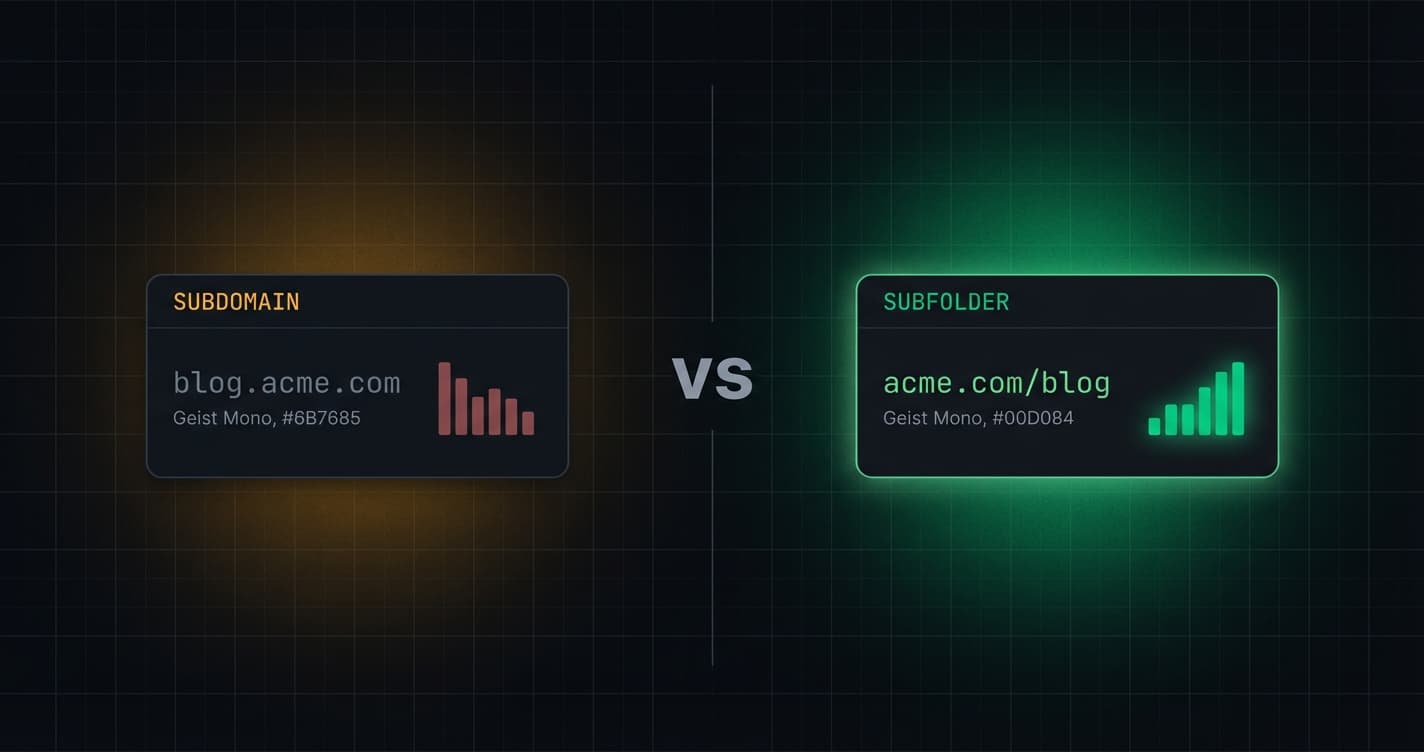
There is a widespread belief in the SEO community that this question is contested — that Google "says" subdomains and subfolders are treated the same. This belief is wrong. It traces back to a misreading of Google statements from 2012–2016 that were always more nuanced than the takeaway suggested.
Here is what the evidence actually shows, as of 2026.
What Google actually says
Google's John Mueller has addressed this question in multiple forums over the years. The most relevant statements:
In a 2021 Google Search Central office hours recording, Mueller said: "In general, we try to be good about figuring out what's relevant to a site. But if you want to be safe, use subdirectories."
In a 2019 Reddit AMA, Mueller wrote: "Subdomains can be fine for things like language variants or completely different products. But if you're thinking about where to put a blog, using a subfolder is simpler and we can usually process it a bit better."
In a 2016 Search Console office hours: "We treat subdomains as separate sites for the purpose of crawling and indexing. We do try to associate subdomains with root domains, but it's not perfect."
The phrase "not perfect" is the key. Google tries to associate subdomains with root domains, but it's an imperfect heuristic, not a guarantee. Subfolders, by contrast, are definitionally part of the root domain — no inference required.
The PageRank mechanism
PageRank flows between pages through links. The amount of PageRank a page can pass to another is governed by the link's position, the linking page's own PageRank, and whether Google treats the link as internal or external.
Internal links (within the same domain) pass PageRank more effectively than external links. The difference isn't binary — it's a continuum — but Google weights internal signals from the same domain more strongly than cross-domain signals.
When your blog lives at blog.yourdomain.com:
- Backlinks to blog posts send PageRank to
blog.yourdomain.com - Links from
blog.yourdomain.comtoyourdomain.comare external links in Google's model - Google's heuristic attempts to associate the subdomain with the root — but imperfectly
When your blog lives at yourdomain.com/blog:
- Backlinks to blog posts send PageRank directly to
yourdomain.com - Links between blog posts and product pages are internal links — full weight
- No inference required — the domain is definitionally the same
The empirical evidence
Several independent studies have measured this effect. The most rigorous:
Moz case study (2013)
When Moz migrated their blog from moz.com/blog (actually already on subfolder) to a restructured URL — and more importantly, when they consolidated several subdomain properties — they documented a 15–20% organic traffic improvement over 90 days in their case study published in the Moz blog.
SEMrush analysis (2023)
SEMrush analyzed 500 e-commerce sites that had completed subdomain-to-subfolder migrations between 2020 and 2022. Results:
SEMrush 2023: Post-migration results, n=500 e-commerce sites
Ahrefs 2024 crawler study
Ahrefs analyzed 10,000 websites and compared Domain Rating against whether content was hosted on subdomains vs subfolders. Their finding: for comparable content quality and publishing frequency, subfolder-hosted blogs had a statistically significant higher correlation with the root domain's DR improvement over a 12-month period.
The correlation doesn't prove causation definitively, but it's consistent with the PageRank mechanism described above.
When subdomains make sense
The case against subdomains isn't absolute. There are legitimate use cases:
Country/language variations
de.yourdomain.com for German content, fr.yourdomain.com for French. This is a legitimate use case because these are genuinely different sites from Google's perspective — different content, different regional signals, different hreflang configurations. The subdomain structure here accurately reflects the site architecture.
Separate products that happen to share a company
status.yourdomain.com for a status page. jobs.yourdomain.com for an ATS-hosted careers page. These serve fundamentally different purposes and audiences — separating them from the main domain is semantically appropriate.
Technical isolation requirements
api.yourdomain.com for an API that shouldn't share sessions, cookies, or CORS policy with the marketing site.
Acquired products or brands If you've acquired a brand and are running it as a separate product line, a subdomain (or separate domain entirely) may be the right choice until you decide on full integration.
What doesn't make sense as a subdomain: your blog, your docs, your help center, your resource library, your case studies — any content that you're creating to rank for keywords and drive traffic to your main offering. This content should live on your main domain.
The crawl budget dimension
Beyond PageRank, there's a second mechanism at play: crawl budget.
Googlebot allocates a "crawl budget" to each domain — a limit on how many pages it will crawl in a given period. This budget is influenced by the site's authority, the crawl rate it can handle, and the freshness of content.
When you have a subdomain and a root domain, Google treats them as separate sites with separate crawl budgets. If yourdomain.com and blog.yourdomain.com are both medium-authority sites, Googlebot splits its attention between them.
When you consolidate to yourdomain.com/blog, Google's crawl budget for your domain now covers both the main site and the blog content. Higher-authority combined domain → more crawl budget → faster re-indexing of new content.
For content-heavy sites publishing frequently, this matters. A site publishing 3 blog posts per week benefits meaningfully from faster crawl cycles.
The internal linking dimension
A third mechanism: internal link weight.
Internal links (within the same domain) are consistently weighted more heavily than external links. When your blog and your product pages live on separate domains, links between them are external — useful, but less powerful.
After consolidation, those same links become internal. A blog post about "how to set up email marketing" that links to your email marketing product page is now passing internal PageRank to that product page. At scale — hundreds of blog posts, each with multiple product links — this compounds significantly.
HubSpot's success as a high-ranking domain is partly attributable to this: their blog is one of the highest-traffic content hubs in B2B software, and every blog post links internally to HubSpot product pages. Those internal links have been building product page authority for years.
The actual decision framework
When to use subdomain vs subfolder
✓ = recommended, ✗ = not recommended, ~ = situational
Subdomain or subfolder: how to decide for your situation
You should migrate to a subfolder if:
- Your content (blog, docs, resources) is on a subdomain
- That content has accumulated backlinks over months or years
- Your main domain's authority is lower than you'd expect given your content investment
- You're running content marketing specifically to improve organic traffic
You should keep a subdomain if:
- You're operating truly separate products or brands
- Language/regional segmentation is your goal
- The technical complexity of shared sessions/cookies is a genuine problem for your use case
The question to ask: "Is this content meant to drive traffic and trust to my main domain?" If yes, it belongs on the main domain, not a subdomain.
The migration risk question
The most common objection: "We've been on a subdomain for 3 years. Won't migrating break everything?"
The short answer is no — if you do it correctly. The key steps:
- Set up 301 redirects from all old subdomain URLs to the new subfolder paths
- Update internal links from any main-domain content pointing to the old subdomain
- Submit the new sitemap to Search Console
- Monitor for crawl errors in the first 30 days
Done correctly, Google follows the 301s, transfers the ranking signals, and your content re-appears in search results at the new URLs. The process takes 30–90 days to fully stabilize, with a possible small dip in traffic during the re-indexing period.
The longer you wait, the more authority accumulates in the wrong place. If you're publishing content on a subdomain every week, every new backlink that content earns is going to the subdomain — not your main domain.
Want the specific numbers?
We documented a real subdomain-to-subfolder migration with 90-day Search Console data. 34% organic traffic increase. The full case study has the timeline, the metrics, and the things that almost went wrong.
Expert insights
"Subdomains are a separate host from the root domain and are treated that way by Googlebot. If you want something to be clearly part of your site, use subdirectories."
John Mueller
Search Advocate, Google
"In my experience auditing hundreds of sites, subdomain consolidation is consistently one of the highest-ROI technical SEO fixes available. It's underrated because it's not glamorous."
Cyrus Shepard
Founder, Zyppy SEO
Related posts